RV bunk mattresses: the size least likely to match a chart
As an Amazon Associate I earn from qualifying purchases. What that means.
Quick answer
Bunks are Measure first in almost every coach: widths from 28 to 35 inches are all normal. Measure the opening, not the old pad, then choose between a stock mattress in the rare matching size and Trim to fit foam cut to your number.
Bunks get whatever floor space is left after the floorplan is drawn. That makes them the one place in a coach where a mattress size chart is actively misleading - two trailers from the same builder, same year, can take different bunk pads.
Measure the opening
Measure the sleeping platform itself - corner to corner, inside any side rails - not the old mattress, which may have compressed or been trimmed by a previous owner. Write down width, length and the height you have under a slide-out or overhead cabinet. Order to the platform.
Three extra checks specific to bunks: the width at the ladder end as well as the far end, because some bunks narrow; the height from the bunk floor to the ceiling above it; and the height of the safety rail, since every inch of mattress you add is an inch of rail you lose.
Where bunks sit in the size chart
| Size | Nominal W x L | Fit class | What that means |
|---|---|---|---|
| RV Bunk (narrow) | 28 x 75 in | Measure first | Bunks vary more than any other RV size. 28, 30, 32, 34 and 35 in widths all exist. |
| RV Bunk (wide) | 34 x 75 in | Measure first | Some fifth-wheel bunks run 35 x 79. Trim-to-fit foam is often the only match. |
| RV Twin | 38 x 75 in | Drop-in | Same footprint as a residential twin. |
| Three-quarter | 48 x 75 in | Trim to fit | No residential equivalent. Cut down from a full, or order foam. |
Comfort without adding height
The usual instinct is to stack a topper on the existing pad. In a bunk that costs headroom and rail height at once. Replacing the pad with denser foam of the same thickness gets most of the comfort back without changing the geometry.
Pads made for bunk widths
Two sizes cover most factory bunks, and both come from a maker that publishes its dimensions. If your tape reads something else, skip to cutting foam below rather than forcing the nearest size.
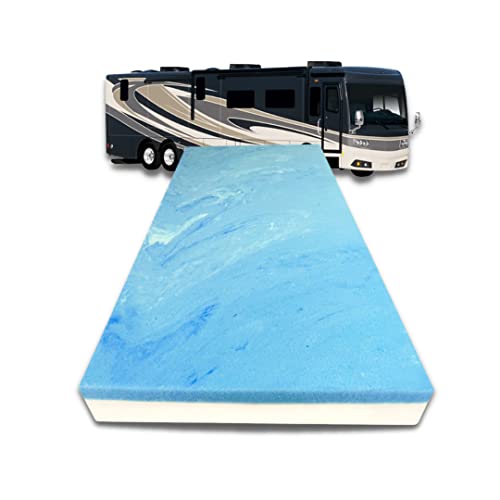 Measure first 28 x 75 x 6
 FoamRushRV Bunk Replacement, 6 in
Six inches of gel foam at 28 x 75, the narrow bunk width. Sold without a cover on the marketplace, so budget for a zippered cover or bedding that can be washed.
Check size and availability(paid link)
Measure first 34 x 75 x 7 FoamRushRV Bunk Replacement, 7 in
The same idea in 34 x 75 and an inch thicker. Check rail height before adding that inch: it comes off the safety rail, not off the ceiling.
Check size and availability(paid link)
Cutting foam to size
Order the next size up and cut down. A long straight blade, a straight edge clamped along the line, and one continuous pass beats sawing back and forth. Cut the cover separately and leave a small allowance; foam compresses at the edges and a cut made exactly to the opening reads loose once it is in.
Questions people ask
What size is an RV bunk mattress?
There is no single answer. Widths of 28, 30, 32, 34 and 35 inches and lengths of 74, 75 and 79 inches are all in production, sometimes across trims of the same model. Bunk dimensions have to be measured.
Can I put a regular twin mattress in an RV bunk?
Only if the bunk measures 38 inches wide, which most do not. A standard twin is 38 by 75, wider than a typical bunk opening, and forcing it in blocks the ladder rail or the bunk door.
How thick can a bunk mattress be?
Thin enough that whoever sleeps up there can still sit up and that the safety rail still stands proud of the mattress surface. Adding four inches of foam to a bunk lowers the effective rail height by the same amount.
Is trimmed foam a reasonable bunk solution?
It is often the only solution, because stock mattresses in odd bunk widths barely exist. Foam sold oversized and cut with a long blade to the measured opening is standard practice for this size.
Sources
- Manufacturer specification pages for each product named, checked on the brand's own site
Last updated 2026-08-03