RV sheets: the five inches that decide whether they stay on
As an Amazon Associate I earn from qualifying purchases. What that means.
Quick answer
If the coach has a short queen, the size to order is Drop-in 60 x 75 and the number to check twice is pocket depth: mattress plus topper, not mattress alone. Household queen sets are five inches too long and come off the foot corners within a night.
Bedding is where the RV size problem stops being abstract. A mattress that is five inches short is a mattress you can still sleep on; a fitted sheet that is five inches long is a sheet that balls up under your hip at two in the morning. The sizes below are the ones coaches actually use, and the second half of this page is the pocket depth question, which is what sends most people back for a second set.
Short queen sheets
 Drop-in 60 x 75
 CGK UnlimitedShort Queen RV Sheet Set
Cut for 60 x 75 with a pocket the brand rates for eight to twelve inches of mattress, which covers a factory mattress with a thin topper but not a thick one. The brand confirms both figures on its own listing.
Check size and availability(paid link)
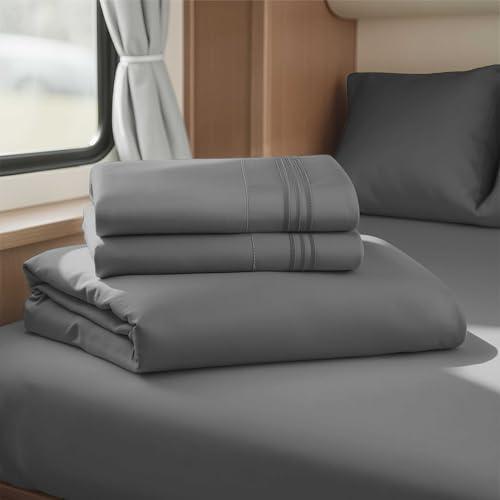 Drop-in 60 x 75
 Hearth & HarborShort Queen RV Sheets
Same 60 x 75 footprint, pocket stated to ten inches. The brand has no RV line on its own site, so the depth here comes from the listing rather than a specification page: fine for a bare mattress, worth measuring against if you sleep on a topper.
Check size and availability(paid link)
One of these carries a maker-rated label and one is listing-only, which is the difference between a figure published on a brand's own specification page and a figure that exists only where the product is sold. What that check involves is on how we test.
Pocket depth is the part people get wrong
A fitted sheet grips by wrapping under the mattress. Too shallow and it will not reach; too deep and the elastic never tightens against anything. Add the topper before you decide: a ten-inch mattress under a three-inch topper is thirteen inches of bed, and a set cut for twelve will lift at the corners exactly where you get in and out.
Measure from the platform to the top of whatever you actually sleep on, with the bedding compressed the way a body compresses it. That number, not the mattress label, is the one to match.
Why household sheets do not work
A household queen is 60 by 80. A short queen is 60 by 75. The width matches, which is why the mistake is so easy to make in a shop: the sheet goes on, the corners hold at the head, and the slack collects at the foot where nobody looks until the first night on the road. RV king is a different trap in the other direction, at 72 by 80 against a household king's 76 by 80. The size chart lists all of them with the fit class for each.
Bunks, and the sizes nobody sells
Bunk pads are cut to the coach, not to a standard, which is why a bunk sheet is so often a twin sheet with the excess tucked under. Three options, in the order they are worth trying: a fitted twin with sheet straps underneath, a set sold specifically for your builder's bunk size if one exists, or a made-to-measure fitted sheet, which costs more than the pad did. The bunk replacement page covers the sizes builders invent and how to measure one properly.
Sheets that stay on a bed you climb into from one side
Most RV beds are boxed in on two or three sides, so nobody makes a bed the way they would at home: you kneel on it, drag the corner, and undo the tuck every morning. Two things help, and neither is a better sheet. Sheet straps or suspenders under the mattress hold the corners through that drag. And a set with a deep enough pocket to reach properly under a mattress that cannot be lifted at the wall side is worth more than thread count in a coach.
Questions people ask
Will regular queen sheets fit a short queen RV mattress?
The width is right and the length is not. A household queen is 60 by 80, a short queen is 60 by 75, so a standard fitted sheet has five inches of slack down the bed. It will go on, it will not stay on: the excess gathers under the sleeper and the corners lift from the foot end first.
What size are RV sheets?
There is no single answer, which is the problem. Short queen at 60 by 75 is the most common, but coaches also come with RV king at 72 by 80, RV queen at 60 by 74 or 60 by 75 depending on the builder, and bunks in sizes no household product is cut for. Measure the mattress you have rather than trusting the brochure.
What pocket depth do I need?
Deep enough for the mattress plus anything on top of it. A topper is the usual reason a fitted sheet that fitted last year no longer does: three inches of topper on a ten-inch mattress needs a pocket rated for thirteen, and most RV sheet sets are cut for eight to twelve.
Do bunk beds need special sheets?
Usually yes, and often nothing off the shelf fits. Bunk pads are cut to the coach rather than to a standard size, so the practical answers are a twin sheet with the excess tucked, a sheet set sold for the specific bunk size if the builder offers one, or a fitted sheet made to measure.
Why do my RV sheets keep coming off at one corner?
Two causes, both mechanical. The mattress sits in a recess or against a wall, so you climb in from one side and drag the sheet with you every time. Or the pocket is deeper than the mattress and the elastic never engages. Sheet straps fix the first; the right pocket depth fixes the second.
Sources
- Manufacturer specification pages for each product named, checked on the brand's own site where one exists
Last updated 2026-09-20